I want healthy hair


You may have done a little research when choosing a shampoo and conditioner. However, you probably haven’t spent much time thinking about whether you’re actually washing your hair correctly. There’s a bit more to it than just wetting your hair, lathering it with shampoo, rinsing, and repeating the process with conditioner—especially if you want optimal results. In this article, you’ll learn the most important principles of proper hair washing.

Carefully comb your hair before washing it. Combing helps remove tangles and knots caused by, for example, styling product residue. We recommend using a high-quality comb that is gentle on your hair.
Don’t rush to apply the shampoo (meer. , Step 1); make sure to thoroughly wet your hair. Check that there are no dry spots in your hair and that your scalp is sufficiently moist. Depending on how long or thick your hair is, this may take longer than you think. Let the water run over your head for at least 1 minute, then run your fingers through your hair to ensure that it (including the ends) is completely wet. If you use lukewarm water, your scalp will open up more easily, and your hair will better absorb the active ingredients from our product. Never use water that’s too hot, as it dries out your hair and increases sebum production.
Apply the right amount—based on the length and thickness of your hair—to the palm of your hand—not too much and not too little. Before applying the shampoo to wet hair, mix it with a little water in your palm. This will prevent direct contact with your scalp and also reduce product waste. Then, using gentle circular motions with your fingertips, apply the lathered shampoo to your entire scalp. Avoid using your fingernails—you could easily injure yourself and irritate your scalp. Throughout the entire shampooing process, focus on cleansing the scalp rather than the ends of your hair. The ends of your hair don’t get oily on their own, so we mainly wash the scalp at the roots regularly; the lathered water will slide down the length of your hair to the ends on its own, without your help.

Our scalp is very sensitive, so we should never scrub it with our fingernails. Shampoo is effective enough to dissolve oil and impurities without much mechanical assistance. Instead, take your time and massage your scalp gently—without using your fingernails—for about 3 minutes. Aim for the same amount of pressure that your hairstylist uses when washing your hair and massaging your scalp.
Spend 1–2 minutes rinsing your hair, and make sure you’ve washed all the lather out of your hair. If you don’t rinse your hair thoroughly, it will be limp and greasy after washing. Before applying conditioner, you need to remove as much water as possible from your hair, so gently squeeze it out.
Gently apply the conditioner from the middle of your hair to the ends. Never apply conditioner directly to the scalp. The hair roots do not need the conditioning provided by the conditioner; the scalp provides that by producing sebum. Use enough to cover your entire head of hair. Try to gently work the product into all strands of hair, especially in the areas that are most damaged. Leave it on for 2 minutes.

Follow the same steps as in step 5 and make sure you've rinsed all the product out of your hair.
After thoroughly rinsing your hair, gently blot it dry with a towel so that water isn’t dripping from it. Be sure to gently press the towel against your hair—do not rub it. Rough rubbing can damage the hair’s structure. If possible, use a microfiber towel. The rougher the fabric, the more damage it can cause to your hair. If time allows, let your hair air dry naturally after towel-drying.

Summer and humid weather can cause some of us to struggle with problems like frizzy hair. Frizzy hair can be frustrating, especially when nothing seems to tame it. As annoying as frizzy hair can be, most of us aren’t exactly sure what causes it, which means we don’t know the best way to manage it. Don’t worry—we’re here to answer all your questions.
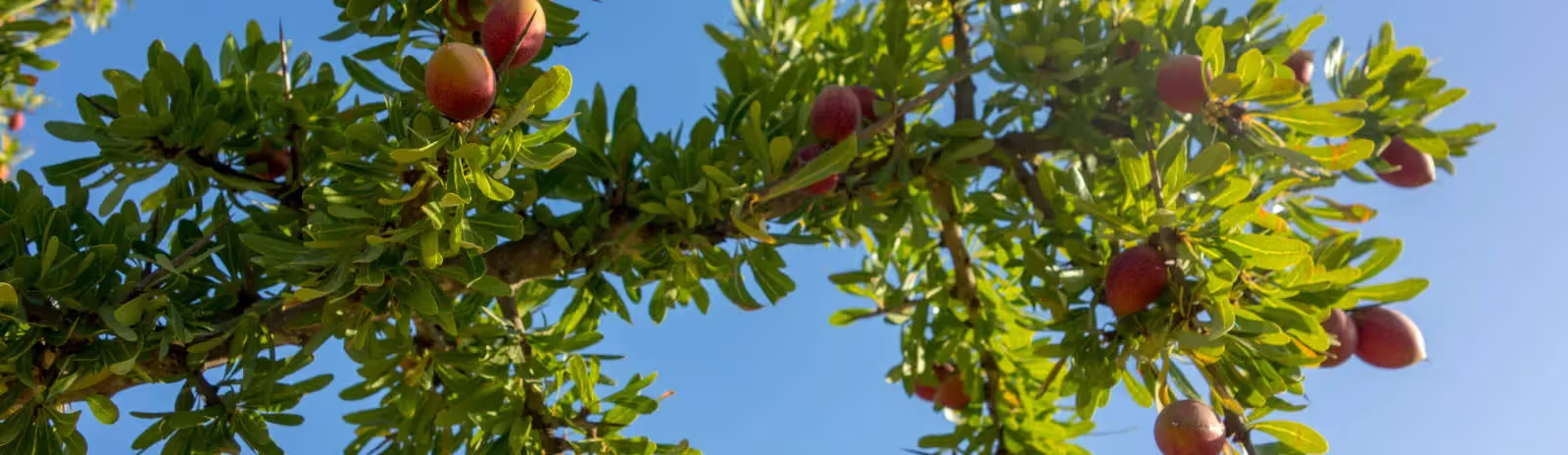
In the world of hair care and cosmetics, plant-based oils are becoming increasingly common ingredients. Hundreds of products claim to work wonders for your skin and hair. Are there real benefits, or is it just marketing? Read on to learn more about argan oil and why it’s beneficial for your skin and hair.
To offset our carbon footprint, we use advanced artificial intelligence technology through pachama.com. We support various projects for forest restoration and conservation around the world. You don’t even have to buy anything from us. We do this because it is one of our core business values: to give back what we have taken from nature.